CVD Diamond OEM Business Continuity Planning for United States RFQs
United States OEM jewelry and component buyers should treat CVD diamond OEM business continuity planning as a dated purchase-order exhibit, not a brochure line. Dual-reactor copy does not protect a drop date. Award manufacturing volume only after the same RFQ returns recovery time in calendar days for rough versus calibrated goods; process-gas and power cover in days, hours, and minutes; reserved finished inventory by SKU in carats, plus backup growth or finishing capacity; a substitution tree that cannot silently change laboratory-grown disclosure or United States origin marking; and a landed-cost and delivery worksheet as of the quote date. Compare those units across vendors, file the documents, then write the approved values onto the order.
A public industrial-diamond BCM policy describes that loop as specifying key operations for early resumption, assessing threats and risks, implementing measures, writing emergency response plans, and running education, training, and assessments (Asahi Diamond Industrial, Risk Management (BCM)). CVD manufacturer sourcing guidance tells buyers to ask whether the plant has multiple gas suppliers or substitute raw-material suppliers, and to treat lead times, minimum order quantities, flexible lots, and buffer stocks as launch-risk controls (Messi Jewelry CVD manufacturer sourcing guide). A public CVD OEM supplier describes matched pairs, calibrated batches, reserved inventory for repeat orders, and custom cutting (Innovation Diamonds). Those pages are evidence types to request. They are not Origin Lab Diamonds capacities, certificates, customer outcomes, or a substitute for a dated quote.
Author: Vincent Xi, Editorial Author, Origin Lab Diamonds (author profile). This page does not claim personal factory visits, operating tenure, awards, tests, or named-client results. Editorial claims below are limited to the cited public pages and to example calculations labeled for replacement in the supplier quote.
United States specification, labeling, landed cost, and delivery controls for CVD diamond OEM manufacturing
A United States program fails continuity if stones exist but the entry or delivery file does not. Write the RFQ so a plant event cannot silently change disclosure, origin marking, who pays the landed-cost stack, or who owns the in-hands date. This page is an RFQ and order-file control set for United States B2B buyers of laboratory-grown CVD diamond manufacturing, not a multi-country market guide.
Specify laboratory-grown CVD diamond on every commercial document, with the quality window (cut/make standard, carat or sieve band, color, clarity, fluorescence). If the OEM may substitute lots after a disruption, the substitute must remain inside that window. U.S. FTC jewelry guidance in 16 CFR Part 23 requires clear laboratory-grown disclosure in marketing and invoicing; confirm the version in force as of the RFQ date with counsel. A growth or polish-site change is not a buyer-accepted right to weaken that wording unless counsel and the purchase order say otherwise. That rule is a disclosure standard. It is not a factory certification and is not claimed here as an Origin Lab Diamonds credential.
Name the importer of record, Incoterm and named place, unpolished versus polished state at export, the HTS classification the broker will use, the United States ship-to location, required in-hands dates, whether partial shipments are allowed, and who pays incremental freight in USD if an emergency air move is used. This article does not publish a duty rate, merchandise processing fee, or freight dollar figure, because those values move with the live entry. Require a landed-cost worksheet as of the quote date, with units (USD per carat or per shipment), scope (named SKU list), and assumptions (weight, value, mode). Any planning number that is not on that worksheet is an example to verify in the supplier quote.
If cutting or polishing country can change under the continuity plan, require a pre-approved origin-marking script for U.S. Customs and Border Protection. A backup cell that keeps reactors running can still block delivery if the mark or invoice is wrong. Continuity of manufacturing is not automatically continuity of a compliant United States entry.
What business continuity planning must cover in CVD diamond OEM growth and finishing
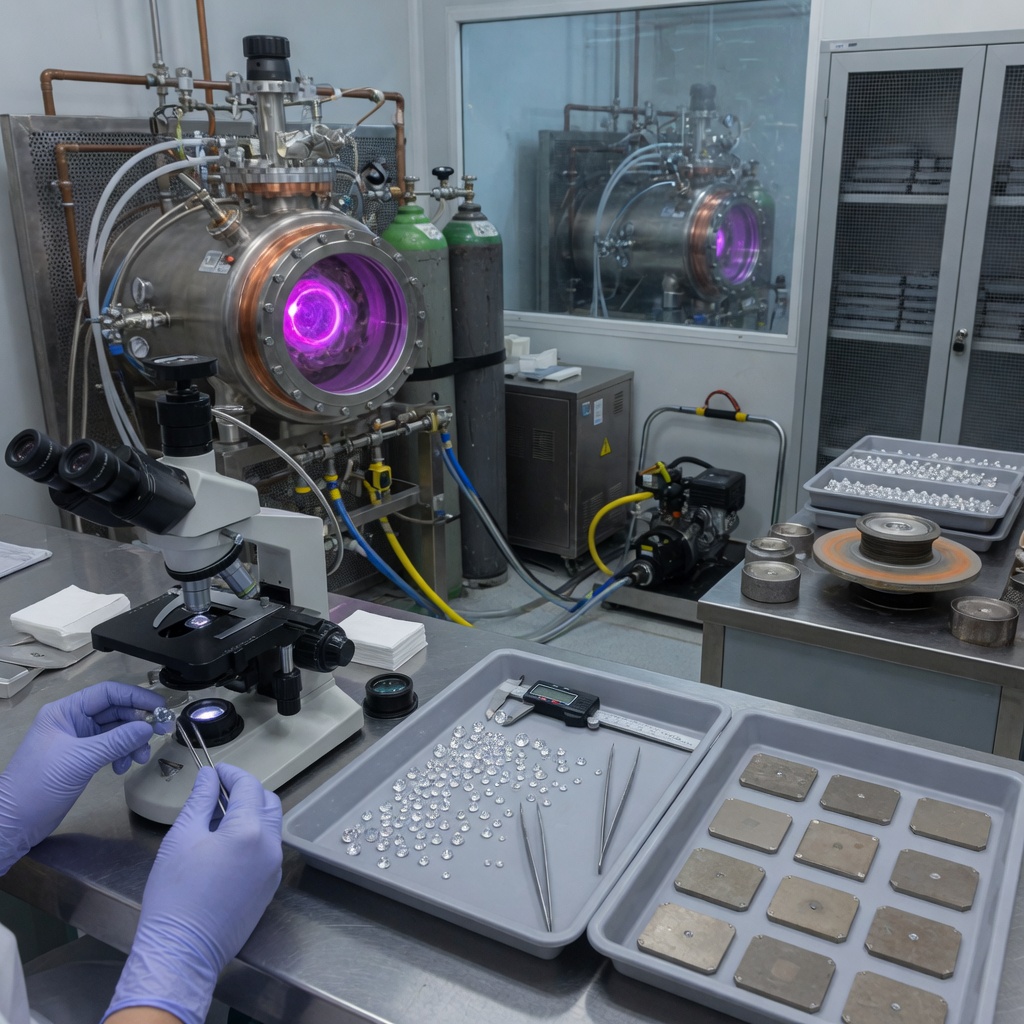
CVD diamond manufacturing is a chained process: substrate and recipe, microwave-plasma growth, interruption-sensitive crystal runs, conversion, cutting and polishing, QC or grading, then calibrated dispatch. Score each step, not only the building. Treat the chain as an RFQ scoring list to confirm with the vendor, not as an Origin Lab Diamonds plant description.
Use the BCM structure published by Asahi Diamond Industrial as a buyer checklist, not as a claim about Origin Lab Diamonds: key operations for early resumption; threat and risk assessment; implemented measures; emergency response plans; training and assessments (Asahi Diamond BCM). Translate that into OEM diamond terms once, then audit the quote against it:
- Key operations: recipe-controlled reactors, process-gas purity, cooling water, vacuum, electricity, growth technicians, cutting and polishing cells, and QC instruments.
- Threats: utility outage, single-source hydrogen or methane, long-lead parts (pumps, magnetrons), wheel or abrasive shortage, key-person absence, logistics congestion, and a finishing-site fire.
- Measures: dual sourcing, on-site gas cover, spare critical parts, reserved finished goods, and a second qualified finishing cell.
- Emergency plan: who aborts a run, who declares a disruption, the customer-notification clock, which SKUs ship from reserve, and who pays expedite freight to the United States ship-to.
- Improvement: exercise dates and open corrective actions.
ISO 22301:2019, if you require it, is a business continuity management-system standard (edition year 2019; confirm whether a later amendment applies as of the RFQ date). Ask whether the vendor holds a current third-party certificate, claims self-alignment, or does not use the standard. Do not infer certification from a policy webpage. A standard’s requirement is not this company’s practice unless a current certificate is attached to the order file.
Example calculation to verify in the supplier quote (not a measured plant result; not an Origin Lab Diamonds figure): if the planning scenario is a 21-calendar-day growth stop and finishing still needs 14 calendar days after rough is available, finished-goods recovery time is 35 calendar days unless reserved polished inventory covers that SKU. If monthly program demand is 80 carats, 35 days is about 93 carats of cover (80 carats/month × 35/30 days, using a 30-calendar-day month assumption). Replace 80, 21, 14, 30, and 93 with the vendor’s measured demand, yield, and calendar before you approve. Units: carats and calendar days; scope: the named SKU list on the RFQ; as-of: the quote date. Later inventory math on this page uses the same labeled 80-carat monthly scenario.
Gas, power, and utility redundancy buyers can measure
Messi Jewelry’s sourcing guide instructs buyers to ask whether the manufacturer has multiple gas suppliers or substitute raw-material suppliers if a primary source fails, and to understand lead times and MOQs when planning inventory (Messi Jewelry). For CVD, typical growth chemistry uses high-purity hydrogen and a carbon source such as methane, plus cooling water and stable electrical supply for plasma. Confirm that chemistry as an RFQ specification with the vendor; do not read it as a measured Origin Lab Diamonds utility model. Require numbers, not adjectives.
Ask for:
- Primary and alternate hydrogen suppliers, contract type (bulk, tube trailer, cylinders), and on-site cover in days at the quoted recipe consumption.
- The same for methane or other carbon-source gas, plus dopant gases if the spec needs them.
- Electrical ride-through: uninterruptible power duration in minutes for controls and vacuum, and generator runtime in hours at the load that keeps reactors in a safe state or in growth, stated as two different capabilities.
- Cooling-water redundancy: second pump or chiller path, and minutes-to-abort if flow is lost.
- Spare magnetrons, vacuum pumps, and other long-lead parts, with quantity and lead time in calendar days.
Example assumption to verify in the supplier quote (not a measured plant result): 10 days of on-site hydrogen at current recipe consumption, plus a secondary packaged-gas dispatch within 48 hours. Units: days of cover and hours to dispatch; scope: the quoted recipe and nameplate or measured consumption; as-of: the quote date. If actual consumption is higher, 10 days becomes a shorter cover.
Dual-gas contracts and generator fuel raise conversion cost per carat. Single-source gas with no on-site cover can lower the quoted price and raise the chance that a crystal run is scrapped. For United States retail drop dates, a scrapped run is often more expensive than the gas premium. Put the premium on the quote as USD per carat so vendors are comparable. A generator that only supports safe shutdown does not protect work-in-process the same way as a generator sized for growth; specify which capability you are buying. If the quote discloses one hydrogen supplier and zero on-site days of cover, treat that as a known performance risk already on the RFQ, not as a later unforeseeable event.
Reserved inventory, backup capacity, and specification lock
Innovation Diamonds publicly offers OEM and white-label production support that includes matched pairs, calibrated batches, reserved inventory for repeat orders, and custom cutting, alongside a self-reported 15,000 to 20,000 carats per month polishing range (unit: carats per month; scope: that supplier’s public polishing statement; as-of: undated in the excerpt used here, with no measurement month and no independent audit) (Innovation Diamonds). Use that language as a template for what to request and audit. Do not read it as Origin Lab Diamonds output or as certified market capacity.
Reserved inventory is the fastest recovery tool for finished jewelry programs because it bypasses growth time. Specify SKU-level carat quantity, sieve or millimeter band, color and clarity floor, fluorescence cap, ownership (vendor-owned call-off versus customer-owned consignment), United States delivery point, refresh rules, drawdown notice in business days, and replenishment lead time in calendar days. State whether reserved goods are already polished and graded or are only allocated rough.
Example calculation to verify in the supplier quote (not a measured plant result; same labeled 80-carat monthly scenario as above): 80 carats per month of 1.00–1.50 mm calibrated melee, 8-week replenishment lead time, plus 4 weeks of safety stock. Lead-time demand is 160 carats (80 carats/month × 2 months). Safety stock is 80 carats. Reserved-stock target is 240 carats. Units: carats, millimeters, weeks, and months; scope: that example melee SKU only; as-of: the quote date. If MOQ is 50 carats per sieve band (example assumption to verify), round each band to the next MOQ and restate the total. Messi Jewelry flags MOQs and predictable lead times as core planning inputs (Messi Jewelry).
Backup growth capacity is slower but protects new makes and larger stones that cannot be pre-stocked economically. Specify how many equivalent reactors can load the recipe, changeover hours, and whether “backup” means idle kit, weekend shifts, or a second site. Idle kit costs capital; overtime costs yield risk; a second site costs process-match risk.
Write a substitution tree so continuity cannot become a quality escape: no substitute; then same sieve and color within one agreed grade; then a buyer-approval gate. Matched pairs and calibrated batches only help if the reserve is held as matched sets, not as mixed leftover. A 240-carat polished reserve on an 80-carat-per-month program (example above) reduces stockout probability and increases working capital and assortment-change risk. Require the vendor to quote the reserve as a separate USD per carat per month holding line.
Pipeline risk assessments and emergency procedures to attach to the PO
Convert Asahi Diamond’s published BCM elements—threat assessment, implemented measures, emergency response plans, and ongoing training—into pipeline artifacts on the purchase order (Asahi Diamond BCM):
- Risk register covering utilities, gases, critical spares, key-person skills, finishing subcontractors, and outbound logistics to the United States.
- Business-impact table with maximum tolerable downtime in hours or days for growth, finishing, and ship-release.
- Emergency procedure: abort criteria for a plasma run, safe-state gas isolation, customer notification within a stated number of hours, which reserved SKUs ship first, and who pays incremental freight in USD.
- Exercise record: last tabletop or live-test date, scenario, and open corrective actions.
- Communications tree with 24/7 contacts and a backup if the plant phone system fails.
Pipeline risk includes stones already in cutting, the courier account, export documentation, and the United States in-hands date. If polish reroutes to a second country, the United States origin mark and FTC invoice language must already be approved. If a partial lot moves by air, the RFQ should state whether the vendor or the buyer pays incremental freight in USD. Tie the BCM exhibit to force majeure before approval: a gas single-source the vendor already disclosed is a known performance risk, not an undisclosed event.
Buyer decision table: continuity options versus verification
Every row is a control a buyer can specify, compare across vendors, verify with documents, approve in a quality file, and write onto an order.
| Continuity control | What to specify | What to verify | Measurable trade-off | United States order check |
|---|---|---|---|---|
| Dual hydrogen and methane supply | Named suppliers; on-site cover in days; secondary dispatch in hours (replace the 48-hour example with vendor data) | Contracts and 12-month delivery log | Higher gas cost vs. lower growth-stop risk | Keep SDS and freight papers aligned if the packager changes |
| Electrical safe-state vs. growth-sustain | UPS minutes; generator hours; which loads are covered | Last load-bank test date and rating in kW | Capital and fuel vs. work-in-process survival | Carve known outage limits out of force majeure |
| Reserved polished inventory | SKU, carats, quality window, location, refresh days | Monthly stock certificate and grading reports | Working capital vs. shorter finished RTO | Invoice must still identify laboratory-grown CVD diamond |
| Backup reactor capacity | Equivalent reactors; changeover hours; site | Equipment list and a trial-run record | Idle capital or overtime vs. rough RTO | Recipe transfer cannot alter undisclosed origin |
| Second finishing cell | Re-qualification sample size (agree n in the quote; example n = 30 stones) | Capability data vs. original spec | Geographic diversity vs. make variation | Re-approve CBP origin mark if country changes |
| Spec-locked substitution | Allowed grade steps; melee sieve bands in mm; pair rules | Written tree signed by QC | Fill rate vs. assortment integrity | Retailer QC protocol still binds returns |
| Calibrated batches and matched pairs | Batch size in carats; pair delta limits | Measurement files for the reserved lots | Higher make cost vs. faster reset after a stop | Keep batch IDs on the US commercial invoice |
| Landed cost and delivery pack | Incoterm named place; importer of record; in-hands date; partial-ship rule; expedite payer in USD | Quote-date worksheet with units and SKU scope | Price vs. on-time United States drop date | No unpublished duty rate; use the live entry file |
| BCM exercise cadence | RTO in days; last exercise date; 24/7 contact | Redacted minutes and open actions | Admin time vs. evidence quality | Attach the exhibit to a PO under the chosen US-state law |
RFQ checklist for United States CVD diamond OEM continuity
Use this list on the RFQ and again on the purchase order. Each item is a specify, compare, verify, approve, or order action.
- State the product as laboratory-grown CVD diamond, with cut, carat or sieve, color, clarity, and fluorescence windows, and whether matched pairs are required.
- Attach a SKU forecast in carats per month and name the United States ship-to location, required in-hands dates, and whether partial shipments are allowed.
- Require a BCM exhibit that lists key operations, threats, measures, emergency procedures, and last training or exercise date, using the public industrial-diamond BCM structure as the evidence pattern (Asahi Diamond BCM).
- Name primary and alternate process-gas suppliers and on-site cover in days at the quoted recipe.
- State UPS duration in minutes and generator runtime in hours, and whether the generator sustains growth or only a safe abort.
- Quote reserved inventory in carats by SKU, ownership model, United States delivery point, refresh cycle in days, and holding charge in USD per carat per month.
- Quote backup growth capacity as equivalent reactors and changeover hours, not as an unspecified surge.
- If a second finishing site is allowed, require a re-qualification sample plan and a pre-cleared United States origin-marking script.
- Lock substitution rules so buffer stock cannot drift outside the quality window; record melee sieve bands in millimeters.
- Disclose MOQs and replenishment lead times in calendar days so inventory math can be checked (Messi Jewelry).
- Require lot traceability from growth run to export carton, including any reserved-inventory draw.
- Provide FTC-compliant invoice language and the importer-of-record / Incoterm named place / landed-cost worksheet as of the quote date (USD; no duty rate is assumed here).
- State customer-notification hours after a disruption, the order of SKUs served from reserve, and who pays incremental freight in USD.
- Tie force majeure to undisclosed risks only; single-source utilities already listed in the quote remain the vendor’s performance risk.
- If ISO 22301 is offered, require the certificate number, registrar, and expiry; otherwise mark “not certified.” Do not equate a webpage with certification.
- Replace every example calculation in this article (93-carat 35-day cover; 240-carat reserve; 10-day hydrogen; 48-hour dispatch; n = 30 re-qualification stones) with vendor-measured values before approval.
How these figures were derived and what still has to be verified
Source context 1: Asahi Diamond Industrial’s public Risk Management (BCM) page, used for process elements of stable supply during disasters (key operations, threat assessment, measures, emergency plans, training). Asahi Diamond is an industrial diamond company; the page is a policy description, not an audit of a gem CVD OEM line.
Source context 2: Messi Jewelry’s public guide to sourcing CVD diamond manufacturers, used for buyer-facing redundancy questions (multiple gas or raw-material suppliers, lead times, MOQs, buffer stocks). It is commercial sourcing content, not a plant measurement.
Method: buyer tasks for this manufacturing intent (production disruption, gas and power redundancy, reserved inventory and backup capacity, pipeline risk, emergency procedures, United States specification/labeling/landed-cost/delivery controls) were mapped to those public statements plus Innovation Diamonds’ homepage claims of reserved inventory, calibrated batches, matched pairs, and a self-reported 15,000 to 20,000 carats per month polishing range (unit: carats per month; scope: that homepage polishing statement; as-of: no measurement month or audit in the excerpt) (Innovation Diamonds). Each statement was converted into an RFQ evidence request or an example calculation labeled for replacement in the quote. Research-source evidence supports factual editorial claims only; it is not keyword-demand evidence.
Limitations: public pages can change and may be undated; self-reported carat throughput is not a third-party measurement; a BCM policy is not a tested recovery time; United States duty, fees, and freight must come from the importer’s live worksheet; ISO 22301 means nothing without a current certificate if certification is claimed; a backup finishing country can change CBP marking even when reactors stay up; peer supplier claims are not Origin Lab Diamonds capabilities. Verify every number, certificate, and origin script on the dated quote before you order.
Discuss Your Requirements
Review our manufacturing capabilities, then share your specifications for a supplier-fit review.